3-Axis Automatic Resin Doming Machine Buying Guide: How to Select the Right System for Your Production

June 10, 2026

Quick Answer

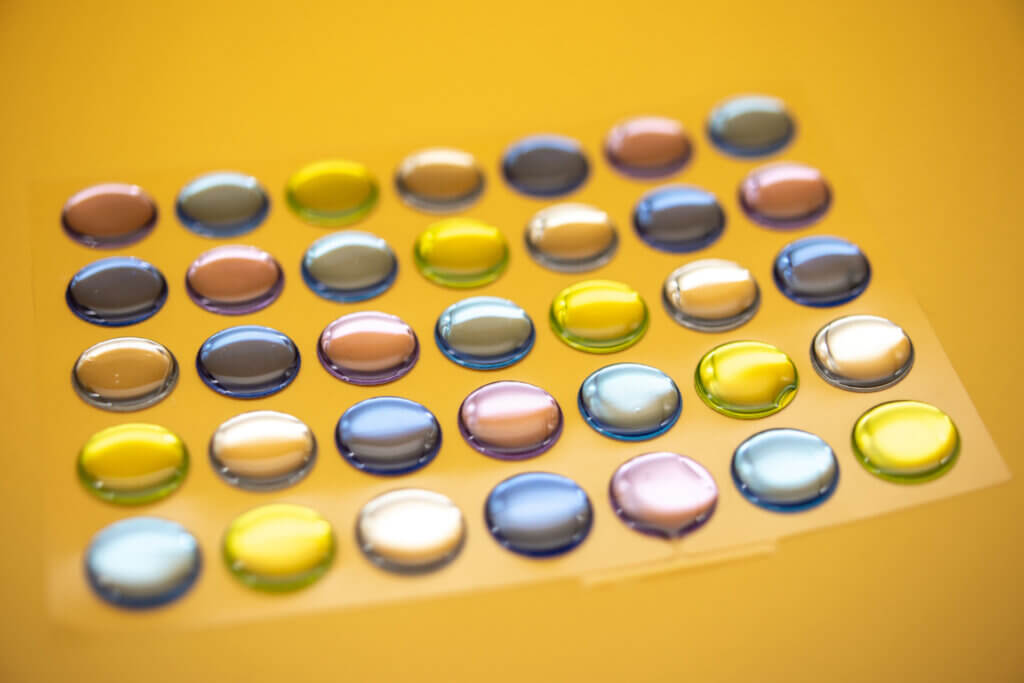
A 3-axis automatic resin doming machine precisely dispenses two-component epoxy or polyurethane resin onto labels, nameplates, and stickers to create a clear, glossy, dome-shaped coating. It uses an XYZ motion system to move a dispensing head across a tray of pre-arranged workpieces, mixing and applying a controlled resin volume. This automated process replaces manual dispensing, greatly improving consistency, throughput, and edge control—especially for medium-to-high volume production of regularly shaped decals. Choosing between a standard 3-axis model, a semi-automatic machine, or a vision-guided system depends primarily on your production volume, label layout complexity, material type, and quality requirements.

Key Takeaways

  • A 3-axis automatic doming machine is best suited for regularly arranged, good-quality label sheets where high output with consistent coating thickness matters.
  • CCD camera-guided systems solve the positioning challenge of irregular sticker layouts and very small parts (down to 3 mm), but come at a higher cost.
  • Polyurethane (PU) resin almost always requires a vacuum degassing unit to prevent micro-bubbles, especially in cold environments.
  • Sample testing with your own materials and artwork is the single most important step before purchasing any doming equipment.
  • Do not assume one machine fits all materials—epoxy and PU resins need different mixing ratios, pump types, and processing conditions.
  • Prepare your application details before requesting a quotation: part size range, resin type, sheet layout, monthly volume, and workshop temperature.

Introduction

If you produce 3D stickers, metal nameplates, automotive badges, or decorative labels, you already know that the doming process defines the final product’s appearance. A poorly domed label with uneven edges, air bubbles, or sticky patches can ruin an entire batch. The shift from manual doming to automation raises immediate questions: Do I need a simple semi-automatic machine, a standard 3-axis system, or a camera-guided model? Which configuration avoids common pitfalls like uncured resin or bubble formation? What information do I need to give a supplier to get the right quotation?

This article answers those questions by explaining how a 3-axis automatic resin doming machine works and, more importantly, how to select the right system for your actual production requirements. The focus is on practical decision factors—not just product descriptions—so you can move from research to a well-informed RFQ.

What a 3-Axis Automatic Resin Doming Machine Is

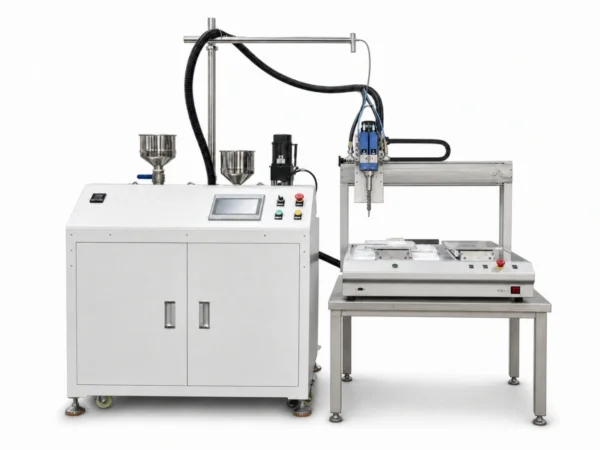
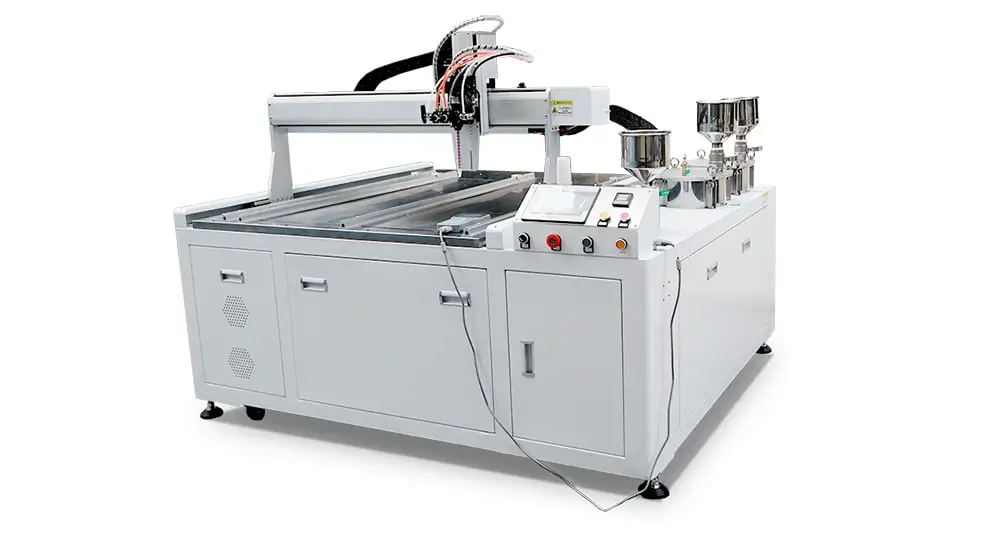
A 3-axis automatic doming machine is a Cartesian-coordinate dispensing robot designed specifically for applying a measured amount of two-component epoxy or polyurethane resin onto flat substrates. The “3-axis” refers to the machine’s movement in X (left–right), Y (front–back), and Z (up–down) directions. The dispensing head, equipped with a dynamic or static mixer, travels between individual sticker positions on a vacuum-holding table and deposits resin that self-levels into a smooth dome.

Unlike general-purpose dispensing robots, doming machines are engineered for:

  • Low-to-medium viscosity resins (typically 300–3,000 cps) that must self-level without overflowing the part edge.
  • Pattern-free coating: the resin is deposited as a single dot or a short bead, not as a drawn line or spiral.
  • Repeatable shot volumes controlled by precision gear pumps or screw pumps, often within ±2% tolerance.
  • Fast cycle times across trays of dozens or hundreds of parts.

In the context of this article, we look at the Robota range of doming machines—including the DJ771 3-axis model, the SJ4060 CCD vision-guided machine, and the PJ180 semi-automatic machine—to illustrate how configuration choices map directly to production needs.

How the 3-Axis Automatic Doming Process Works

Understanding the workflow helps clarify what “automatic” actually means and what still requires operator attention.

Step 1 – Tray loading. The operator places a sheet or tray of pre-cut labels face-up on the table. For a standard 3-axis machine, the labels must be arranged in a known, consistent grid; the dispensing program relies on fixed coordinates.

Step 2 – Program selection. Via the touchscreen PLC controller and a handheld teach pendant, the operator recalls a saved program for that specific label layout, resin type, shot size, and dispensing pattern.

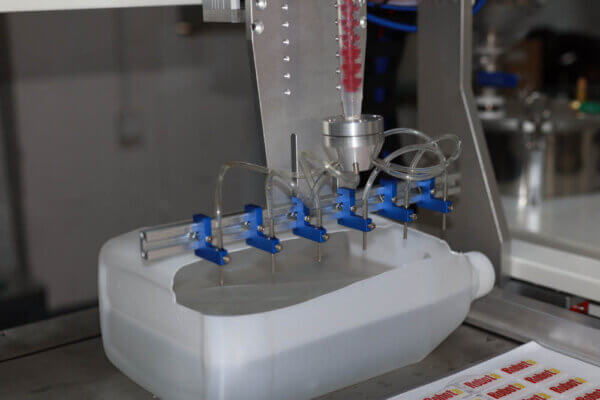
Step 3 – Auto dispensing. The X-Y axes move the dispensing head over the first label. The Z-axis lowers the nozzle to a pre-defined height. The gear pump meters the mixed resin for a pre-set time or volume. The resin is deposited, and the head moves to the next position. Dynamic mixing at the nozzle tip ensures the two-component resin (e.g., epoxy 3:1 or PU 1:1) is thoroughly blended immediately before dispensing.

Step 4 – Tray removal and curing. After the entire tray is domed, the operator removes it and places it in a separate curing area (ambient or heated, depending on resin). No machine curing is involved; the doming machine handles only dispensing.

Where semi-automation fits: The PJ180 semi-auto machine uses the same gear pump and dynamic mixing technology, but the operator holds the handpiece and manually moves from part to part. This is suitable for very short runs, prototyping, or mixed batches where automation programming isn’t justified.

Where CCD vision changes the sequence: The SJ4060 machine replaces the fixed program with a camera that automatically detects each sticker’s position and angle. The dispensing path adjusts in real time. This is critical for irregular layouts, individual kiss-cut stickers on a carrier sheet, or very small parts where manual alignment would be impossible.

Who Should Consider a 3-Axis Automatic Doming Machine?

You are a strong candidate for a standard 3-axis machine (like the DJ771) if:

  • You produce more than 5,000–10,000 sheets per month with regular, predictable sheet layouts.
  • Your labels are 20 mm × 20 mm or larger, and positional accuracy of ±0.2 mm is acceptable.
  • You use epoxy resin (3:1 ratio) or polyurethane, and your workshop temperature stays above 18 °C.
  • You want to reduce manual labor while increasing per-tray output, with cycle times under 2 seconds per dot.

This machine type effectively bridges the gap between manual hand dispensing and fully automated vision-guided systems.

When This Solution Is NOT the Best Choice

Even the best 3-axis machine will struggle or become economically questionable in several situations:

  • Highly irregular sticker layouts. If your sheets contain mixed shapes, random positions, or rotated labels, a fixed-program 3-axis system will take longer to achieve optimal results. A CCD vision model (SJ4060) is the correct choice.
  • Very small parts (smallest 3 mm). Dispensing tiny dots manually or semi-automatically is challenging; automating it without vision is impractical. A camera system ensures the nozzle lands exactly where needed.
  • Polyurethane resin without degassing. PU is far more sensitive to moisture and entrapped air than epoxy. Without vacuum degassing of the resin tank, bubbles will form. Even a well-tuned 3-axis machine cannot compensate for un-degassed PU resin.
  • Prototyping or order quantities of a few hundred pieces per run. The programming and setup time of a fully automatic machine may outweigh the speed benefit. A semi-automatic system (PJ180) offers a more balanced ROI for very low volumes.
  • Workshops consistently below 15 °C without heating. Resin viscosity rises sharply in the cold, causing flow problems, inconsistent shots, and long leveling times. If you cannot heat the workshop or the machine’s tank and hose, automatic dispensing reliability drops.

Key Factors to Consider Before Buying

As you evaluate machines, these technical and operational factors directly affect which configuration will work for you.

1. Application scenario and workpiece size

Define your smallest and largest parts. The DJ771 can be customized with a table up to 1200 mm × 1000 mm, but typical label sheets are much smaller. The SJ4060’s travel is 400 mm × 600 mm with a dual-table design, allowing one table to be loaded while the other is dispensing.

2. Resin type and mixing ratio

  • Epoxy 3:1 typically works well with gear pumps and standard dynamic mixers.
  • PU 1:1 benefits from a degassing-ready tank and potentially a screw pump for viscosity stability. Tell the supplier your exact resin model (e.g., Polyurethane 618AB-18 or a specific epoxy) for compatibility testing.

3. Production volume and cycle time

Calculate parts per month, per day, and per shift. A DJ771 with a single dispensing head might dispense 30–60 parts per minute depending on dot size and tray layout. Multi-head configurations increase throughput proportionally but add cost.

4. Accuracy and repeatability requirements

For high-value products where a dome edge defect causes a rejected part, consider whether ±0.1 mm positioning is needed. CCD vision consistently delivers higher positional accuracy than blind 3-axis relying on operator tray placement.

5. Automation level

  • Semi-automatic (PJ180): Operator controls nozzle placement; best for startups, short runs.
  • Automatic 3-axis (DJ771): Programmed tray dispensing; best for regular sheets, medium high volume.
  • Automatic CCD (SJ4060): Programmed with vision correction; best for irregular layouts, very small parts.

6. Installation environment

Measure ambient temperature and humidity. If below 18 °C, budget for a tank and hose heating system. High humidity accelerates PU cure and can cause cloudy domes if not controlled.

7. Future scalability

Can the machine be later upgraded with a multi-head, larger table, or degassing? Some platforms (like the DJ771) offer modular options; verify this with the manufacturer.

Comparison of Available Options

The table below compares the three representative machine types based on the Robota range. Use it to narrow your search.

Option Mejor para Advantages Limitations Selection Notes
Semi-Auto Doming Machine (PJ180) Prototyping, very low volume, mixed batches Low cost, easy to learn, no programming; immediate feedback on resin behavior Fully operator-dependent; inconsistent dot placement; fatigue on large jobs Ideal for initial market testing or doing small custom orders in-house.
Standard 3-Axis (DJ771) Medium to high volume, regular layouts Fast, repeatable, lower operator cost; multi-head expandable Requires consistent tray positioning; cannot correct for rotated/shifted stickers Perfect for label converters running epoxy at scale. Test with your own sheet layouts.
CCD Vision-Guided (SJ4060) Irregular layouts, tiny parts, high-mix production Auto alignment, dual-table for continuous loading, high accuracy Higher upfront cost; more complex maintenance; requires stable lighting If your sheets aren’t perfectly gridded, this is the only practical automatic option.
With degassing & heating add-on PU resin; cold environments Prevents bubbles and maintains flow consistency Adds cost, power consumption, and maintenance points Add this to either DJ771 or SJ4060 if using PU, especially in winter.

This table reflects capabilities described in the product documentation. Actual suitability must be verified through sample testing.

Decision Matrix: Which Configuration Based on Your Conditions

Use this quick reference to map your situation to a likely configuration.

Situation Recommended Option Reason
Regular label sheets, >5000 pcs/month, 20 mm+ DJ771 3-axis automatic High throughput, fixed coordinates, reliable epoxy doming
Irregular sticker sheets, mixed sizes, down to 3 mm SJ4060 CCD automatic Camera corrects positioning; dual-table maintains speed
Polyurethane resin DJ771 or SJ4060 + vacuum degassing PU traps air; degassing tank is mandatory
Cold workshop (10–18 °C) Any automatic + heating system Keeps resin viscosity in recommended range
Low volume (few hundred per month), many SKUs PJ180 semi-automatic Setup time exceeds run time for automatics
Need to scale later DJ771 with modular options Multi-head and larger table can be field added (confirm with supplier)

How to Match the Solution to Your Application

Scenario A: A label converter producing 50,000 epoxy-domed metal nameplates per month.

  • Situation: All nameplates are the same size, placed in a consistent 10×10 grid on standard trays. Epoxy doming is the core value-add service.
  • Recommendation: Standard 3-axis automatic machine (DJ771). The regular grid allows a simple, fast program. Multi-head option increases output further. No vision needed.
  • Before purchase: Send 50–100 nameplates with your actual adhesive backing and artwork to the supplier for free sampling. Confirm that resin adhesion, edge definition, and curing match your quality standard.

Scenario B: A promotional product manufacturer producing small, multi-design sticker sheets for retail.

  • Situation: Each sheet contains 20–30 different sticker shapes in a non-repeating, artist-designed layout. Quantities are 2,000–5,000 sheets per order, but sheets change every 2 weeks.
  • Recommendation: CCD vision automatic machine (SJ4060). The camera reads the sheet and adjusts dispensing on the fly—no re-programming each time. Dual tables allow one to be loaded while the other is dispensing, maintaining throughput despite the mixed layout.
  • Before purchase: Provide 3–5 different sheet designs for the supplier to film a test video. Confirm that the vision system correctly identifies and domes the smallest elements.

Scenario C: A startup testing the market for custom domed stickers.

  • Situation: Orders are small (100–500 pcs), designs change frequently, and cash flow is tight. The owner needs to learn the process before scaling.
  • Recommendation: Semi-automatic machine (PJ180). Low capital outlay, quick to learn. The operator gains first-hand understanding of how resin flows and cures on their own materials—critical knowledge for later equipment upgrades.
  • Before purchase: Test the resin compatibility with your adhesive label stock. Some adhesives can cloud or delaminate under uncured epoxy.

Common Buying Mistakes

  1. Choosing a machine based on price without sample testing.
    • Problem: A machine that works perfectly with the supplier’s test resin may fail with your own resin and substrate. This leads to expensive rework, inconsistent quality, and possible return hassles.
    • Avoid: Insist on free sample processing with your actual materials and production files. Watch test videos showing the entire tray from loading to finished doming.
  2. Ignoring the degassing requirement for polyurethane.
    • Problem: PU resin mixes viscous and inherently traps air. Without a degassing tank, micro-bubbles appear hours after doming, ruining appearance. No dispensing technique can completely compensate.
    • Avoid: If PU is even a possible future material, either include a degassing unit upfront or ensure the machine can be retrofitted. Budget for this as an essential accessory, not optional.
  3. Overestimating production capacity from single-dot cycle times.
    • Problem: A supplier’s “1.5 seconds per dot” spec assumes ideal fluid and no operator delays. Real-world throughput is lower after accounting for tray changes, occasional nozzle cleaning, and setup.
    • Avoid: Calculate required monthly output with a 20–30% buffer above the machine’s rated continuous speed. Discuss realistic daily output expectations with the supplier based on your specific tray size and dot volume.
  4. Neglecting workshop temperature effects.
    • Problem: Resin viscosity changes significantly between summer and winter. An epoxy that flows beautifully at 25 °C may become sluggish and dome unevenly at 15 °C, causing edge defects or inconsistent thickness.
    • Avoid: Measure your workshop temperature range throughout the year. If it falls below the resin manufacturer’s recommended range, include machine heating for the tank and hose. A heated tank adds cost but prevents seasonal quality drift.
  5. Assuming all 3-axis machines are equivalent.
    • Problem: General-purpose 3-axis dispensing robots often lack the specific gear pump metering, dynamic mixing, and vacuum table integration needed for doming. They struggle with flow control and self-leveling materials.
    • Avoid: Buy from a manufacturer that specializes in doming applications and can provide application-specific advice, not just motion hardware.

Supplier Selection and RFQ Checklist

Prepare this information before contacting a supplier. It ensures you receive a realistic quotation and configuration, not a generic list price.

# What to Prepare Why It Matters
1 Workpiece dimensions and material Determines table size and the need for vacuum or fixturing.
2 Sheet layout: regular grid or irregular? Decides between standard 3-axis and CCD vision.
3 Smallest and largest part dimensions Confirms nozzle size and positioning resolution.
4 Resin type and brand (epoxy 3:1 / PU 1:1) Dictates pump type, mixing method, degassing, and material handling.
5 Viscosity and working time of resin Affects pot life management and dispensing parameters.
6 Required monthly output (parts or sheets) Sizes the number of dispensing heads and table configuration.
7 Workshop temperature range Validates need for heating systems to maintain optimal resin viscosity.
8 Available compressed air and power supply Ensures factory floor compatibility.
9 Sample parts for free testing The only way to verify process compatibility before payment.
10 Operator skill level and training expectations Helps supplier prepare suitable manuals and video training materials.

Suppliers such as Robota offer free sampling services, custom operation videos with English subtitles, and after-sales technical support. Confirm these details during your inquiry.

Preguntas frecuentes

Q: What is the most important factor when choosing a doming machine?

A: The most critical factor is the match between your actual workpiece layout and the machine’s positioning method. If your stickers are placed exactly the same way on every tray, a standard 3-axis machine is straightforward and fast. If the layout varies, a CCD vision system is the only reliable choice. This decision should come before other considerations like speed or price.

Q: Should I choose automatic or semi-automatic equipment?

A: Choose semi-automatic if your monthly output is under a few thousand parts, you change designs frequently, or you are still validating the doming process. Choose automatic when monthly volumes grow beyond roughly 5,000–10,000 parts and you need consistent, repeatable results without depending on individual operator skill.

Q: I use polyurethane resin. Do I really need a degassing system?

A: Yes, in most cases. PU resin tends to entrap air during mixing, leading to micro-bubbles that ruin optical clarity. A vacuum degassing tank is strongly recommended as a standard accessory for PU applications. Without it, bubble-related rejects commonly increase, especially in cooler temperatures.

Q: What information should I send to a supplier to get an accurate quotation?

A: Send your label sample or sheet layout, the resin brand and mixing ratio you use (or plan to use), the smallest part dimension, your monthly production target, and your workshop temperature. This lets the supplier recommend a specific configuration—machine type, pump, optional heating/degassing, and table size—rather than a base model price.

Q: Can I test my own materials before buying?

A: Most specialized doming machine suppliers offer free sample testing. You send your sticker sheets and resin; they process a batch and provide a video. This is the best way to see how the machine handles your exact materials and to catch any adhesion, clouding, or edge problems before committing.

Q: Is it possible to upgrade a standard 3-axis machine with a camera later?

A: Typically no. The mechanical frame and control architecture differ substantially. If you anticipate needing vision correction in the near future, it’s more cost-effective to start with a vision-guided system rather than attempting a retrofit that may be unreliable or unsupported.

Conclusión

Choosing a 3-axis automatic resin doming machine isn’t about picking the fastest or most advanced model—it’s about aligning the machine’s positioning logic, dispense method, and material handling with your daily production reality. For regular sheets and high volumes, a DJ771-type 3-axis machine delivers consistent throughput. When layouts are unpredictable, the SJ4060’s CCD vision becomes the enabler of automatic production, not an expensive luxury. And for polyurethane resin users, degassing isn’t optional.

The most practical next step is to collect a representative set of your own labels, choose a resin, and request a sample doming demonstration from a supplier. That single test run will reveal more about compatibility than any specification sheet. Equipped with the selection factors, comparison table, and RFQ checklist above, you can now communicate your requirements clearly and get a configuration that works—not just a machine that moves.

Contáctenos

Complete el siguiente formulario con su información básica para ayudarnos a comprender su situación actual rápidamente.
*Sus datos se mantendrán estrictamente confidenciales con nosotros.