
Choosing between a semi-auto and automatic doming machine should not start with the word “automatic.” It should start with your product layout, order stability, sheet size, operator workload, positioning risk and resin behavior.
For resin domed labels, decals, nameplates, badges and promotional products, the practical path is often staged. Many buyers start with a PJ180 semi-auto doming machine, then move to a desktop 3-axis platform or a DJ771 floor-standing 3-axis system when orders become repeatable. Compare a CCD vision-guided doming machine when placement varies, or when SJ4060 visual path creation and editing would make frequent irregular-design changes more practical.
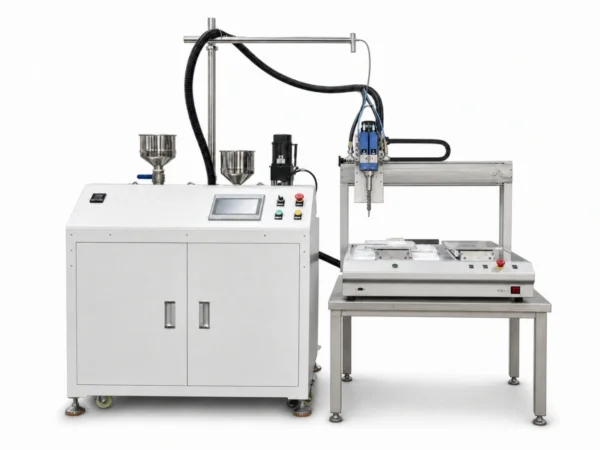
What Changes from Semi-Auto to Automatic
In resin doming production, “automatic” usually means the movement path is automated. The resin metering and mixing system can still be stable on a semi-auto setup. The bigger difference is how product positioning, path repeatability and operator workload are handled.
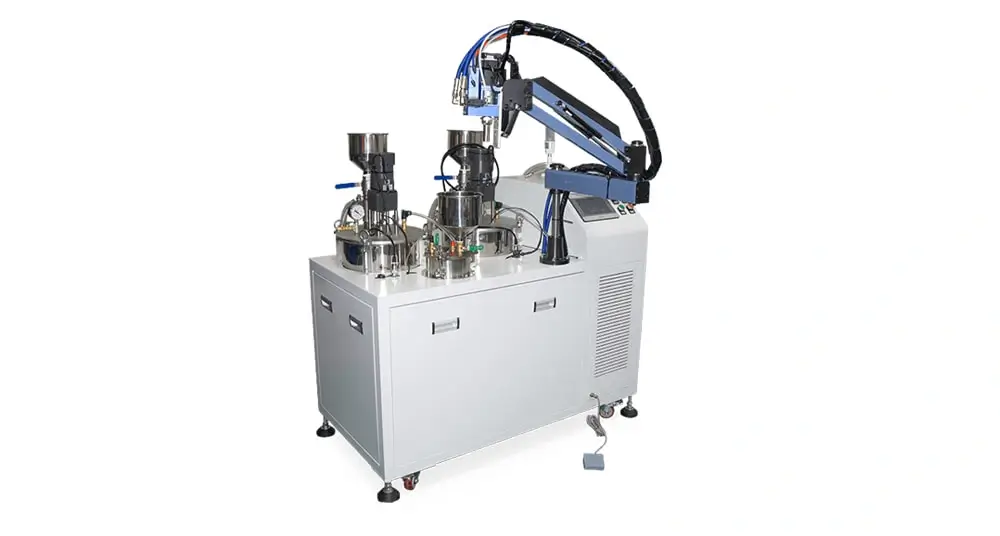
Semi-auto
Operator flexibility
The operator manages more placement and workflow decisions. This is useful when products change often or samples need testing.
3-axis
Repeat path control
The machine repeats saved dispensing paths, which helps when products are arranged consistently on sheets.
CCD
Recognition and visual path work
The camera can align dispensing paths when product placement or printed position varies. On SJ4060, operators can also create and edit irregular-label paths on screen when that workflow is useful.
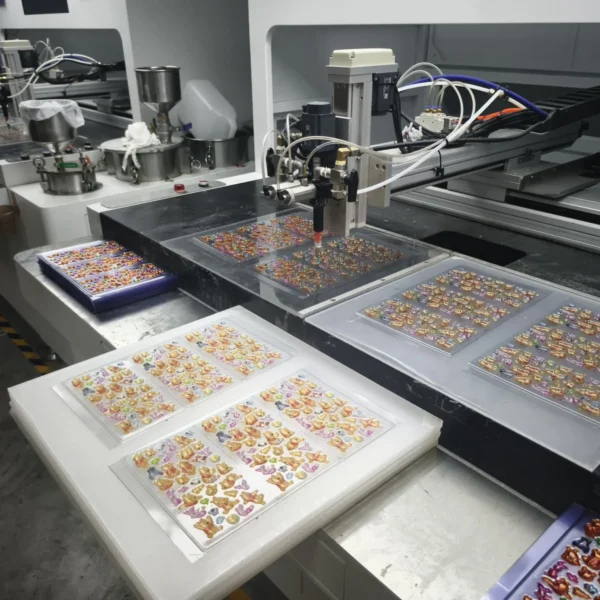
Machine and Resin Should Be Checked Together
The machine controls dispensing and positioning, but resin controls flow, bubble release, surface finish, flexibility, UV resistance and curing behavior. This is why the real question is not only “semi-auto or automatic.” It is which machine and resin setup can produce your product reliably.
Use the doming resin selection page when the product will be used outdoors, needs flexibility, has a high dome, or must resist yellowing and handling wear. For a deeper resin comparison, review epoxy vs polyurethane doming resin.
Machine
The machine controls placement method, path repeatability, dispensing movement and operator workload.
Resin
The resin controls flow, bubbles, curing, hardness, flexibility and weather resistance. Both choices must be validated together.
Recommended Upgrade Path
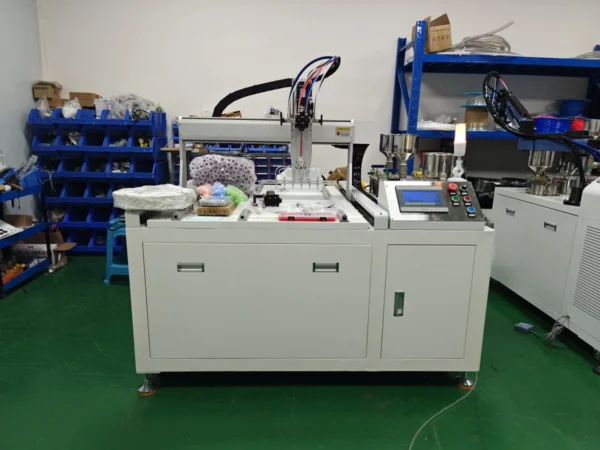
- Start with PJ180 semi-auto when you are validating samples, material, resin and basic workflow.
- Move to desktop 3-axis when regular sheet layouts begin to repeat and compact automation is enough.
- Choose DJ771 floor-standing 3-axis when repeat production, larger sheet area and stable layout justify a larger platform.
- Compare CCD/SJ4060 after testing the actual layout, recognition conditions and path-setup workload.
What to Prepare Before Asking for a Recommendation
Prepare product type, material, sheet size, product arrangement, monthly volume, use environment, target dome height and photos or artwork files. These details help confirm whether the issue is output, positioning, resin behavior or all three.
Recommended Next Pages
- How to Choose the Right Sticker Doming Machine – choose by layout, volume and positioning risk.
- Doming Machine Selection Center – compare semi-auto, 3-axis and CCD paths.
- PJ180 Semi-Auto Doming Machine – for samples, flexible small batches and process validation.
- 3-Axis Automatic Label Doming Machine – for stable repeat sheet production.
FAQ
Is a semi-auto doming machine only for beginners?
No. Semi-auto can be the right long-term choice for small batches, frequent product changes, sample testing and flexible production.
When should I upgrade from semi-auto to a 3-axis platform?
Upgrade when product layouts become repeatable, sheet placement can be controlled and manual movement becomes the bottleneck.
Is DJ771 just a bigger automatic machine?
DJ771 is best understood as a PJ180 resin system combined with a floor-standing 3-axis platform. Its 700 x 700 x 100 mm travel suits larger regular sheets and repeat production.
Should I choose CCD vision instead of 3-axis automation?
Compare CCD when camera alignment can address placement or print-position variation, or when frequent irregular-design changes make SJ4060 visual path work more practical.
Does automatic dispensing solve air bubbles or curing problems?
Not by itself. Bubbles, curing, yellowing, edge overflow and dome height are also affected by resin type, viscosity, degassing, temperature, mixing and material compatibility.
Can I choose the machine before choosing the resin?
You can shortlist the machine first, but final confirmation should include resin testing, especially for outdoor use, flexible products or high dome requirements.
Conclusion
Semi-auto and automatic doming machines are different ways to divide work between the operator and a repeatable path. Upgrade when controlled repeat layouts make manual movement the bottleneck; evaluate CCD/SJ4060 separately for position variation or frequent irregular-design changes.