
Quick Answer
Single-head and multi-head resin doming describe how many dispensing needles apply resin at the same time. They do not describe how automatic the machine is. A PJ180 semi-auto machine, a DJ771 3-axis machine, and an SJ4060 CCD vision machine can all be evaluated with single-head or compatible multi-head dispensing.
Choose a single head when the product is very small, layouts or resin volumes change frequently, or placement accuracy is more important than parallel dispensing. Choose multiple heads when several identical products repeat at compatible spacing and can follow the same dispensing path. More heads can reduce the number of passes, but accepted output does not increase automatically in direct proportion to nozzle count.
For simple, regularly spaced sticker sheets using the same number of needles and comparable metering pumps, the pure dispensing rates of PJ180, DJ771, and SJ4060 may be closer than their automation levels suggest. Their main differences are tray indexing, position recognition, operator workload, and positioning-related reject risk.
Key Takeaways
- Head count and automation level are separate decisions. A semi-auto, 3-axis, or CCD system may use one needle or several compatible needles.
- Single-head dispensing protects flexibility. It is often the first configuration to test for small products, changing layouts, different resin volumes, or tight placement tolerances.
- Multi-head dispensing needs repeatable geometry. Product pitch, needle spacing, shared paths, target volume, and flow balance must remain compatible.
- Pump selection must protect the smallest shot. Combined flow is useful only when the metering system can still control the smallest required resin volume.
- Validate accepted output, not nozzle multiplication. Test alignment, balance, cleaning, tray handling, curing, inspection, and rejects with the actual layout.
Single-Head and Multi-Head Are Dispensing Configurations
A single-head configuration has one active dispensing point. On PJ180, the operator may position or move the tray manually. On an automatic machine, the same single needle can follow a programmed or vision-corrected path across many products during one job.
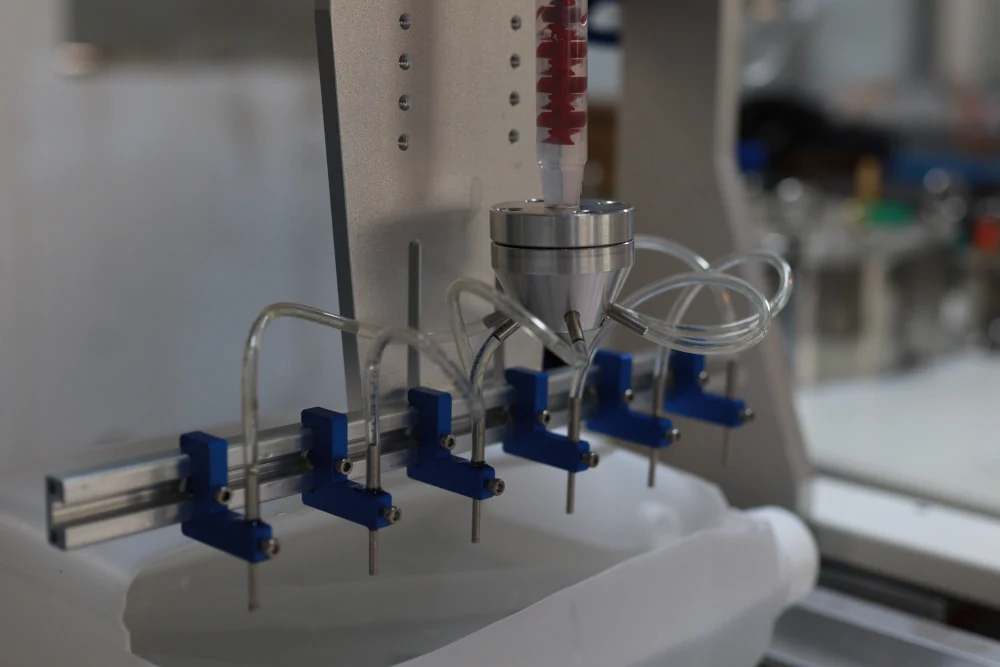
A multi-head configuration uses several needles to dispense at compatible positions in parallel. The needles normally move together, so the products must repeat at suitable spacing and require the same or compatible path. The assembly must also distribute resin consistently to every active outlet.
| Decision factor | Single-head | Multi-head |
|---|---|---|
| Active dispensing points | One point at a time | Several validated points in parallel |
| Best layout | Small, varied, irregular, or precision-sensitive products | Identical products with repeatable pitch and path |
| Main advantage | Flexible placement and finer control | Fewer dispensing passes on compatible layouts |
| Main limitation | More sequential movement | Stricter spacing, alignment, flow-balance, and cleaning requirements |
| Motion control | Can be manual, 3-axis, or vision-guided | Can be manual, 3-axis, or vision-guided |
When Single-Head Dispensing Is the Safer Choice
Single-head dispensing is the better starting point when one or more of the following conditions apply:
- The product or resin area is very small and has limited placement tolerance.
- The tray contains different shapes, orientations, or target resin volumes.
- Product spacing does not match a repeatable multi-needle arrangement.
- The dispensing path is complex and cannot be repeated as the same offset path under several needles.
- New materials, artwork, dome heights, or resin settings are still being validated.
- Reject risk from a small placement error is more costly than the time saved by parallel dispensing.
This is why a single head can remain the correct configuration for high-value or high-volume work. The decision is based on the smallest controllable shot and placement tolerance, not only on the order quantity.
When Multi-Head Dispensing Creates Real Value
Multi-head dispensing becomes useful when the layout allows several needles to perform the same work at the same time. A suitable job normally has:
- Identical or path-compatible products arranged in regular rows or columns.
- Stable center-to-center spacing that matches an adjustable needle arrangement.
- The same target resin volume and dome requirement at every parallel position.
- A tray, sheet reference, or fixture that preserves the required alignment.
- A metering-pump configuration with enough controlled flow for all active needles.
- A loading, curing, and inspection workflow that can keep up with the shorter dispensing cycle.
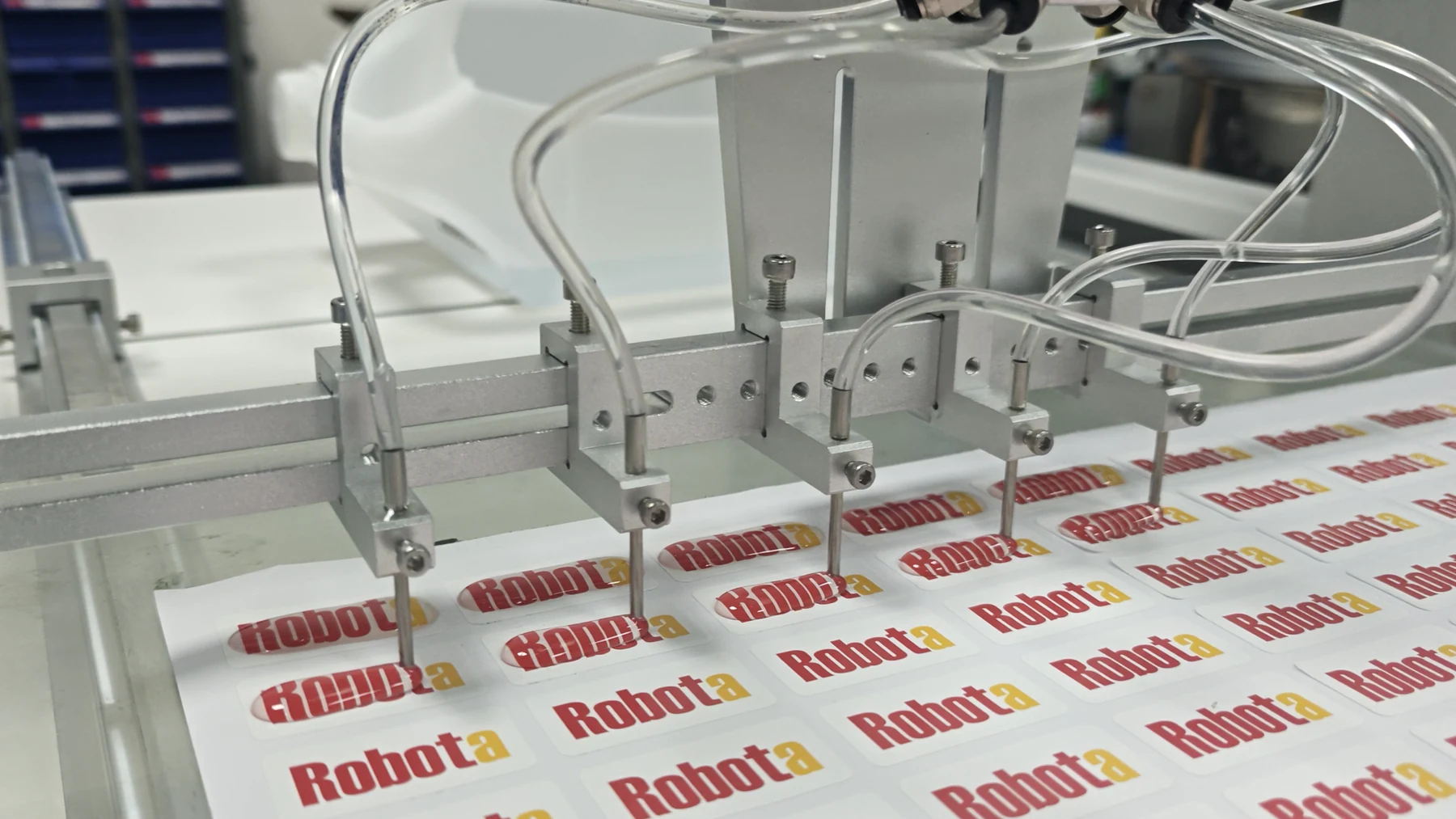
Multi-head is therefore a layout-dependent configuration, not a general “high-output” switch. If only some positions align, if the artwork changes frequently, or if the smallest product cannot tolerate the shared alignment error, a single head may produce more accepted parts even though it makes more movements.
In this SJ4060 five-needle label case, five needles process four rows of five identical labels. Needle 1 is the reference; the other needles follow fixed offsets. Label pitch and X-axis alignment must match the module. The needles do not independently correct shifted labels.
Why Output Does Not Increase Linearly With Nozzle Count
Several needles can dispense in parallel only when the shared configuration remains controlled across the complete path. Check four head-specific limits:
- Spacing and path compatibility: every active needle must stay correctly positioned over its matching product.
- Pump displacement and combined flow: the pumps must feed all outlets while retaining control of the smallest required shot.
- Outlet balance: start, stop, delivered volume, and dome behavior must remain consistent from one outlet to another.
- Changeover work: alignment, priming, cleaning, and inspection can offset part of the theoretical parallel gain.
Use How to Estimate Resin Doming Production Output to add loading, complete tray timing, curing capacity, yield, and shift planning after the head configuration has passed these checks.
Small Products Need a Small-Shot Test
A multi-head assembly introduces shared spacing and alignment tolerances. A larger metering pump can deliver more resin per revolution, but the selected pump and control method must still meter the smallest target volume repeatably.
There is no universal product-width threshold that proves a multi-head setup will or will not work. Test the smallest resin area, target volume, dome height, edge distance, path, needle, pump displacement, and acceptable reject limit. If shared spacing or delivered-volume control cannot meet the criterion, use a single head, smaller pumps, or another validated configuration.
Do not select the greatest number of needles or the largest pumps before confirming the smallest product and narrowest resin area that the line must produce reliably.
How PJ180, DJ771, and SJ4060 Use Single or Multiple Heads
The three platforms use the same general two-component metering, mixing, and dispensing principle. Their main difference is how the product is positioned; head count remains a separate configuration choice.
| Platform | Positioning method | Single-head or multi-head fit |
|---|---|---|
| PJ180 | The operator positions or indexes the tray. | Either configuration can be tested when the operator can repeat the required tray positions and the shared nozzle spacing matches the layout. |
| DJ771 | The machine repeats saved coordinates after the tray or fixture is referenced. | Either configuration can be used on stable repeat layouts; multi-head value depends on compatible spacing, paths, pumps, and resin flow. |
| SJ4060 | Vision locates suitable printed or product features when actual placement varies. | Either configuration can be used. Vision corrects placement; multiple heads reduce passes only when relative spacing and paths remain compatible. |
For the wider automation decision, read the Semi-Auto vs Automatic Doming Machine guide. Use the 3-axis buying guide or CCD vision guide when fixture repeatability or camera recognition is the main question.
Match the Head Configuration to the Product Layout
| Production situation | Head configuration to test | Positioning approach |
|---|---|---|
| Samples, changing artwork, or mixed resin volumes | Single-head | Manual or automatic, depending on path and repeatability |
| Regular sticker sheets with identical spacing | Multi-head if spacing, path, and flow tests pass | PJ180, DJ771, or SJ4060 selected by labor and positioning risk |
| Very small stickers or narrow resin areas | Single-head with smaller pumps | Choose motion control separately from the precision requirement |
| Complex or variable sticker positions | Usually single-head; multi-head only if relative spacing repeats | SJ4060 when vision correction removes measurable positioning risk |
| Rigid parts held in a repeatable fixture | Single or multi-head, depending on fixture pitch | DJ771 often provides strong value when coordinates remain stable |
| Free placement that fixtures cannot control reliably | Single or compatible multi-head after a recognition test | SJ4060 vision positioning |
For layout-specific requirements, review the production guidance for domed decals. For fixture-controlled rigid products, compare the requirements for domed badges; the same fixture-first principle should also be evaluated for nameplates, automotive emblems, and keychains.
Metering Pumps, Resin, and Multi-Nozzle Balance
Each machine model can be configured with different metering-pump sizes. There is no reliable fixed dispensing-speed range that applies to every PJ180, DJ771, or SJ4060 installation. Pump selection must account for the resin ratio, total target volume, number of active needles, and the smallest shot that must remain controllable.
- A larger pump can support higher resin volume but may reduce adjustment resolution for very small products.
- A smaller pump provides finer volume control but may take longer to deliver a large combined multi-head dose.
- The A and B pump relationship must match the resin mix ratio.
- Every active outlet should be checked for consistent start, stop, and delivered volume.
- Viscosity, temperature, mixer condition, hose condition, and nozzle restriction can affect flow balance.
Review the doming resin selection center before finalizing the pump and head configuration. Pump combinations are sample-testing directions, not guarantees based only on product width.
How to Validate the Configuration Before Purchase
- Define the smallest and largest products. Record the narrowest resin area, product dimensions, target dome height, and required volume.
- Map the complete tray. Provide product count, row and column spacing, orientation, and the tray reference or fixture method.
- Select candidate head configurations. Confirm needle spacing, path compatibility, and which positions can dispense in parallel.
- Match the resin and pumps. Test the actual resin ratio, viscosity, pump displacement, and combined multi-head flow.
- Run complete tray cycles. Include positioning, active dispensing, tray indexing, loading, unloading, and cleaning.
- Inspect every outlet and repeat the test. Check dome volume, edge placement, bubbles, start-stop behavior, and consistency across representative runs.
- Calculate accepted shift output. Include curing, inspection, interruptions, and rejected parts rather than relying on theoretical needle count.
A controlled sample run provides more useful evidence than a catalog head-count comparison. For a purchasing decision, verify repeatability over a representative production run rather than judging only one fast cycle.
Common Buying Mistakes
- Assuming output rises in direct proportion to nozzle count. More needles reduce movements only when the entire resin and handling workflow supports them.
- Selecting multi-head before checking the smallest product. One narrow product may determine the pump and head configuration for the whole production range.
- Treating multi-head as automatic positioning. PJ180 still requires manual tray movement; DJ771 requires a repeatable reference; SJ4060 uses vision to correct position.
- Choosing CCD because a product looks complex. A stable fixture may control badges, nameplates, emblems, or keychains without vision.
- Ignoring outlet balance and maintenance. A multi-nozzle setup must be evaluated for equal volume, cleaning access, purging, and restriction at every outlet.
- Using a generic pieces-per-hour claim. The same machine can produce very different accepted output when product size, pump, resin volume, loading, or reject rate changes.
What to Send for a Reliable Recommendation
- Product photos, dimensions, and the narrowest resin area
- Artwork or dispensing path for the smallest and largest products
- Complete tray layout, product count, and center-to-center spacing
- Target resin volume or dome height per product
- Resin type, A:B mix ratio, viscosity, and use environment
- Proposed number of needles and metering-pump sizes, if already known
- Tray reference, fixture method, and expected position variation
- Accepted output target per shift and acceptable reject rate
- Loading, cleaning, curing, and inspection workflow
These details allow the supplier to test single-head and multi-head configurations under comparable conditions. If you are still deciding between platforms, use the sticker doming machine selection guide to compare product layout, positioning risk, and resin validation before requesting a final configuration.
FAQ
Is a multi-head resin doming setup always faster?
No. It can reduce the number of dispensing passes on a compatible repeat layout, but accepted output still depends on pump capacity, resin volume, path, tray handling, cleaning, curing, and rejects. If alignment or flow balance is unstable, a single head may produce more accepted parts.
Can PJ180 use multi-head dispensing?
Yes. PJ180 can use a compatible multi-head set when the product spacing, needle spacing, resin flow, and operator workflow support it. The operator still indexes or positions the tray manually.
Do DJ771 and SJ4060 still need a single-head or multi-head decision?
Yes. Three-axis movement and CCD vision control positioning; they do not eliminate the head-count decision. Either platform may use one needle or several compatible needles depending on the product size, layout, path, pump configuration, and required precision.
Should stickers below 2–3 mm use multi-head dispensing?
Single-head dispensing with suitably small metering pumps is normally the safer configuration to test first. The approximate 2–3 mm width is a practical warning threshold, not a universal specification. The actual decision depends on shape, target volume, resin behavior, and acceptable edge tolerance.
Can a multi-head setup dispense different shapes at the same time?
Only when the shapes can follow compatible offset paths and require compatible resin delivery. If each product needs a different path, orientation, or volume, single-head dispensing is normally more practical.
How many dispensing needles should I choose?
There is no universal number. Start with the tray pitch, compatible parallel positions, combined resin volume, pump capacity, flow balance, cleaning requirements, and the smallest product. Validate the proposed number of needles on the real tray before purchase.
Does a multi-head configuration make the machine fully automatic?
No. Multi-head describes simultaneous dispensing, not product positioning. PJ180 remains manually indexed, DJ771 follows saved coordinates after repeatable placement, and SJ4060 uses vision to recognize positions within its working area.
Conclusion
Single-head and multi-head resin doming solve different production problems. A single head provides the flexibility and fine control needed for small, varied, or precision-sensitive products. Multiple heads reduce dispensing passes when product spacing, path, resin volume, pump capacity, and alignment repeat reliably.
Choose the head configuration before assuming that a higher automation level will create higher output. Start with the smallest product, map the real tray, select compatible pumps and needles, and test a complete production cycle. Then choose PJ180, DJ771, or SJ4060 according to the amount of tray handling, coordinate control, or vision correction the real workflow requires.